
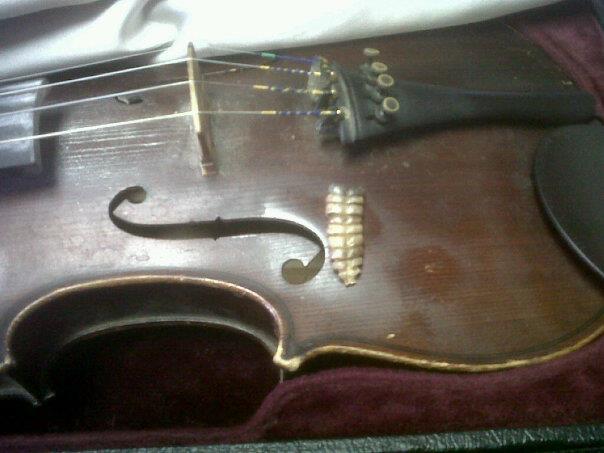
1. It's a good luck thing.
2. Back in the old day's a fiddler might hang his fiddle up outside on the porch when he/she was not fiddling. Mud daubers or wasps found the inside of the fiddle an ideal home by flying into the "F" holes. The fiddler would put a rattle snakes rattler inside his/her fiddle so when the wasp got inside it's wings would vibrate the rattle, thus, scaring the varmint off.

| Date: 12/06/21 The reason you put a rattlesnakes tail inside your fiddle. The fiddle or violin has always been thought to be the devils instrument. The morning star is said to have created the most beautiful music for god and he was god's favorite angel for it. The fiddle player can sometimes be drawn to late night party's at June joints, who're houses of the rising sun. If your playing is good enough to catch the ear of Satan he can go inside your fiddle an tempt you into all kinds of wicked deeds. The rattle is to scare away old scratch from taking up residence inside the soul of you fiddle and your mind. Plus it's cool. Submitted by: Ryan Chaney |
| Date: 03/13/21 I was told that the rattles inside your fiddle will bring you good luck. With my fiddling, I needed all the help I could get, but I wasn't about to go out and find the nearest rattlesnake. Someone else said you need to actually go out and kill the snake yourself. But I cheated; someone I knew gave me some rattles from a snake they had already killed. I put them in the fiddle and figured it could work some magic into my playing. They've been in there for several years now and people say I play better than ever. Maybe it worked. People ask how I can sound so good, but I won't reveal the secret. I just tell them to practice harder. That works just as well. Submitted by: David Garelick |
| Date: 03/13/21 The fiddle was my great grandfather’s, who lived and played in Oregon in the last third of the 19th century. John Peter Johnson was his name. Born in Denmark, emigrated to Minnesota and thence to the west. He appears to have started out as a classical violinist, but ended up playing in popular dance venues. Family lore said the rattles were to bewitch his playing—give it magical powers. Submitted by: Carol Clover |
|
In this
video clip from the documentary �Sprout Wings and Fly�, Tommy Jarrell talks about putting the rattler in to keep spiders from building cobwebs in the fiddle. His fiddle, in the Smithsonian now, had two rattlers in it. wonder if you can buy rattlesnake rattles at the local music shop? Fun topic...thanks! Submitted by: Christine Lovelace |
Submitted by: Janet Lettrich, fiddler, 3rd Sunday String Band |
When I was a small boy playing the Fiddle, my Dad gave me a Rattle Snake tail to put in my Fiddle! I wondered at the time why he did this? Only to find out later. If you are sawing too hard, you could hear the buzz of the rattles. The smooth playing produced a sweeter sound and the tail didn't buzz. The Snake is the bad one in the Bible, and creates all kind's of noise in our lives. It's better to play with the grace of the Lords gift, than to beat the fiddle to death trying to play it! If you put a rattler's tail in your Fiddle, listen for the buzz. If you hear it, just take a deep breath and look up! Play it again, you'll feel better and you won't hear the buzz, and that Fiddle under your chin, will make you, and everyone around you feel relaxed and happy! Submitted by: Billy starfiddler1@live.com |
Alan Jabbour, retired field researcher for the Smithsonian (and the guy who collected many of those great recordings!) has a rattler's tail in his fiddle. He says it is to lend "a rhythm section" to his playing. Now, I don't know when he is doing a dance that anyone can hear it (although, he does amplify, now...) but when he plays live or on some of his recordings you CAN hear the swishing of the dried tail inside his instrument!
STRINGcerely,
Jan Farrar-Royce, President CT ASTA
A violin sings. A fiddle dances.
The player makes it music!
|
I read that some believe it "sweetens" the sound of their instrument. And recently someone told me that mice like to enlarge the f holes in a violin, if the violin is left lying on a table at night. But if a mouse jumps onto the violin and hears the rattle inside, it will get scared and go away. Anyway, it's a charming tradition that some continue to follow. Submitted by: Scott Pendleton sp@isystant.com |
Submitted by: Bev Conrad. |